
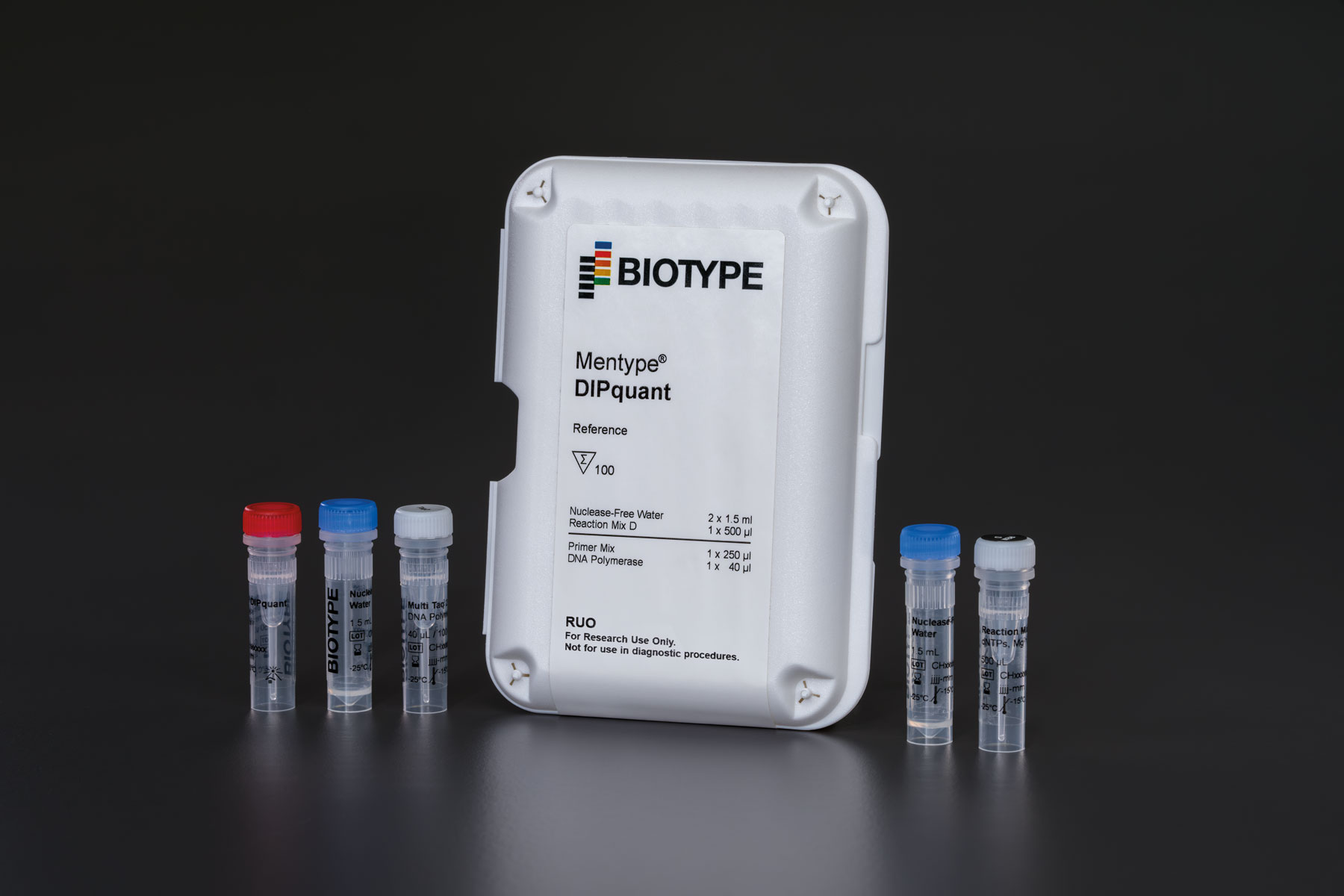
Mentype® DIPquant
High sensitivity chimerism monitoring
Features
- Highly sensitive solution for chimerism quantification
- Detection of minor target ratios down to 0.05 % up to 12.5 % chimerism
- Performed on standard qPCR systems
Following the initial genotyping with Mentype® DIPscreen, the qPCR-based assay Mentype® DIPquant can be applied for relative chimerism quantification. Fast, easy workflow and high sensitivity make Mentype® DIPquant ideal for routine chimerism analysis, when DNA input is not a limiting factor. It is therefore ideal for all research applications requiring highly sensitive chimerism analysis. If the DNA amount is limited, semi-quantitative analysis with Mentype® DIPscreen is recommended.
Biomarkers
Insertion-deletion polymorphism (DIPs or INDELs), Reference gene
Product Specifications
- Panel
- 56 allele specific singleplex assays 1 Reference assay
- Reactions
- 3 allele specific assays + Reference assay in duplicates (8 reactions per sample)
- PCR controls
- 2 (PC via existing samples or DIP Positive Control, NTC)
- Sample input
- 250 ng gDNA from peripheral blood
- Sensitivity
- ≥ 0.05 %
- Turnaround time
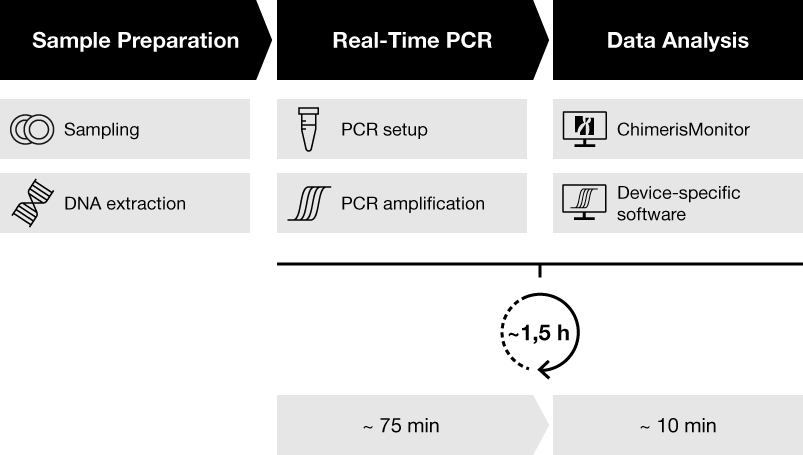
- ~ 1.5 h after nucleic acid preparation
- Detection
- Relative quantification
- To be used with
- Standard qPCR cycler (FAM)
- Data analysis
- ChimerisMonitor (RUO), Cycler specific software, ∆∆Ct calculation
Workflow
Scientific Background
The term “chimerism” refers to an organism that combines several genetically distinct cell lines within a single body. Human chimerism refers to the presence of genetically distinct cell populations within a single individual. This condition can arise naturally, such as through tetragametic fusion, twin‑twin cell exchange, or maternal fetal microchimerism, or artificially through medical procedures like bone marrow or organ transplantation. Chimerism is fundamentally a biological state, not inherently pathological, and plays an important role in understanding human developmental biology. In evolutionary and developmental research, chimerism offers insights into cell lineage tracing, developmental plasticity, and immune tolerance. For example, microchimerism demonstrates how foreign cells can persist for decades, providing a natural model for long‑term cell engraftment and inter-individual cell transfer.
Molecular chimerism analysis is carried out by the detection of deletion/insertion polymorphisms, which are extremely suitable for analysis by allele-specific qPCR technology as compared to other DNA-sequence motifs.
Product References
- Hernández-Blanco et al. The phase I RELEASE clinical trial to evaluate the safety of NK cells in COVID-19. iScience 28, 111698, https://doi.org/10.1016/j.isci.2024.111698 (2025)
- Ferreras, C. et al. Results of phase 2 randomized multi-center study to evaluate the safety and efficacy of infusion of memory T cells as adoptive therapy in severe acute respiratory syndrome coronavirus 2 (SARS-CoV-2) pneumonia and/or lymphopenia (RELEASE NCT04578210). Cytotherapy 26, 25-35, https://doi.org/10.1016/j.jcyt.2023.10.002 (2024)
- Al-Akioui Sanz, K. et al. Familial CD45RA– T cells to treat severe refractory infections in immunocompromised patients. Front. Med. 10. https://doi.org/10.3389/fmed.2023.1083215 (2023)
- Huyveneers, L. E. P. et al. Autopsy Study Defines Composition and Dynamics of the HIV-1 Reservoir after Allogeneic Hematopoietic Stem Cell Transplantation with CCR5D32/D32 Donor Cells. Viruses 14. https://doi.org/10.3390/v14092069 (2022)
- Pérez-Martínes, A. et al. Phase I dose-escalation single centre clinical trial to evaluate the safety of infusion of memory T cells as adoptive therapy in COVID-19 (RELEASE). EClinicalMedicine 39. https://doi.org/10.1016/j.eclinm.2021.101086 (2021)
- Gómez-García, L. M. et al. A phase II clinical trial of infusing haploidentical K562-mb-IL15-41BBL activated and expanded Natural Killer cells as consolidation therapy for pediatric acute myeloblastic leukemia. ESS Open Archive. DOI: 10.22541/au.160192968.85891275/v1 (2020)
- Navarro-Bailón, A et al. Short Tandem Repeats (STRs) as Biomarkers for the Quantitative Follow-Up of Chimerism after Stem Cell Transplantation: Methodological Considerations and Clinical Application. Genes 11, 993. https://doi.org/10.3390/genes11090993 (2020)
- Salgado, M. et al. Mechanisms That Contribute to a Profound Reduction of the HIV-1 Reservoir After Allogeneic Stem Cell Transplant. Annals of Internal Medicine 169, 674-683. https://doi.org/10.7326/M18-0759 (2018)
- Sellmann, L. et al. Diagnostic value of highly-sensitive chimerism analysis after allogeneic stem cell transplantation. Bone Marrow Transplant 53, 1457-1465. https://doi.org/10.1038/s41409-018-0176-7 (2018)
- Navarro-Bailón, A. et al. A Novel Quantitative PCR Approach Targeting Insertion/Deletion Polymorphisms (Indel-PCR) for Chimerism Quantification: Finally High Sensitivity and Quantification Capacity Together. Blood 126, 4227. https://doi.org/10.1182/blood.V126.23.4277.4277 (2015)
- Stahl, T. et al. Digital PCR to assess hematopoietic chimerism after allogeneic stem cell transplantation. Experimental Hematology 43, 462-468. https://doi.org/10.1016/j.exphem.2015.02.006 (2015)
- Willasch, A. M. et al. Monitoring of Hematopoietic Chimerism after Transplantation for Pediatric Myelodysplastic Syndrome: Real-Time or Conventional Short Tandem Repeat PCR in Peripheral Blood or Bone Marrow? Biol Blood Marrow Transplant 20, 1918-1925. https://doi.org/10.1016/j.bbmt.2014.07.030 (2014)
Resources

Ordering Information
Mentype® DIPquant (allele specific assays, Reference)
Size: 25 reactions
Cat. No.: BT00011 – BT00067
Status: RUO
Mentype® DIPquant Reference
Size: 100 reactions
Cat. No.: BT00068
Status: RUO
Product Request

MODAPLEX
Bench-top system for molecular multi-marker testing


